
Literary Fiction | Short Stories | Stage Plays
Can You Find Goodness in Everyone, Even When They Behave Badly?
James English’s short stories have appeared in New Delta Review, Hayden’s Ferry Review, Writers’ Forum, Hobart, Sonora Review, The Stockholm Review of Literature, Post Road, and The Baltimore Review, among others. The Nebraska Review nominated him for a Pushcart Prize.
His short plays have been read at venues in Newburyport, MA, Independence, KS, and Aylsham, UK. The Radio Theatre Project, St. Petersburg, FL, produced his short play “Saint Rita.” It can be heard on SoundCloud.
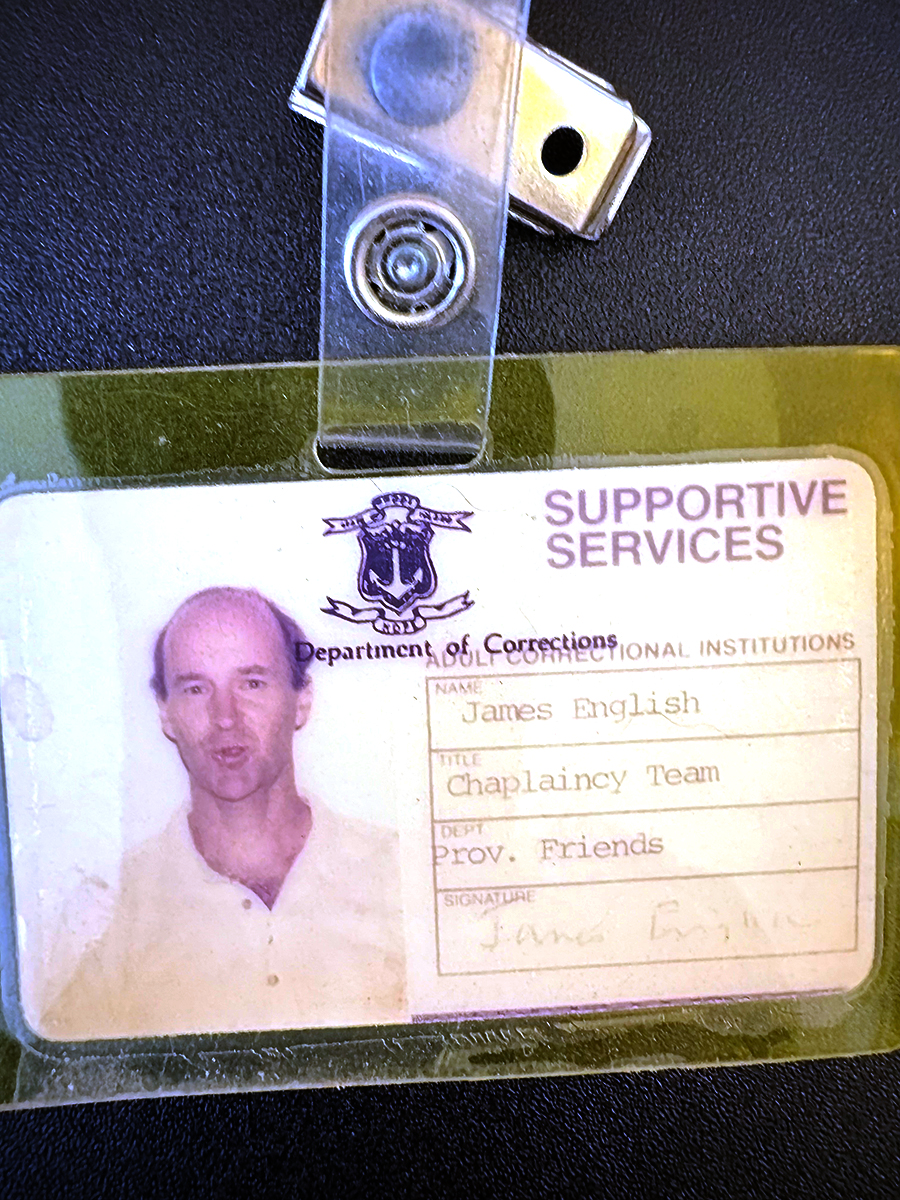
He has written a memoir about conducting Quaker Meeting among minimum, medium, and maximum security inmates at the Adult Correctional Institutions in Cranston, R.I.
He lives in Providence with his wife. They have three children.




“I read your memoir in two sittings. I’m glad I did. It’s wonderful, in a rare class by itself. The stories about the inmates are extremely moving.”
—Jon Wolston, poet, psychiatrist, and author of Pulled Into Providence.
Work in Progress (a memoir)
The Honey Locust Tree, a 52,000-word memoir, takes the reader on a journey to the men’s minimum, medium, and maximum security units at the Adult Correctional Institutions, Rhode Island’s state prison. They join me as I attend Quaker meetings with inmates in chapels and reconfigured classrooms. Prisons are noisy places and sitting in silence with inmates was extraordinary. The title is inspired by the words of an inmate: “I wish I could touch a tree.”
The memoir isn’t only about prison. Other things happened during my three years at the A.C.I. that made me think hard about the inner light. A student at the school where I worked, a Quaker school, brought a bullet to class and I had to punish him. A pedophile trapped our eight-year-old daughter on the telephone and terrified her. An inmate in medium security who most embodied the inner light committed suicide upon his release. I found myself wondering again and again: How do people nurture the inner light? Can it be dimmed or even snuffed out? How strong is the inner light in me?
The Honey Locust Tree offers readers a rarely seen view of a prison, a glimpse of a middle school, and some unexpected insights about my family. The three work together in surprising ways.
From the Blog
The Students Ask to Have a Lock-In
Just before lunch, two eighth-grade girls appeared at my office door. The tall girl was slender and tipped forward from the weight of her backpack. The short girl wore a pink headband. The tall girl said, “Can the middle school have a lock-in?” “Come on in.” Students...
On How We Recover From Our Mistakes
A central theme of the memoir I’ve written, The Honey Locust Tree, has to do with mistakes. How do we recover from our mistakes? Do we need help—from a parent, friend, society, a prison—to recover from our mistakes? Who can doubt the pain, and the power, of a major...

An Inmate Shows Sympathy
We’d just sat down in the medium security chapel when Ralph Maloney, an inmate who never missed a Quaker Meeting, took two envelopes out of his pocket. He looked at the six inmates sitting in the circle of chairs. “Chaplain Medina’s mother died recently. Can you guys...
